
“Do not merely listen to the word, and so deceive yourselves. Do what it says.” — James 1:22
In 1968, I returned to the Caribbean, bright-eyed and bushy-tailed.
My first job at The University of the West Indies, St. Augustine, was to establish a Biometrics Unit to support research and development in crop and livestock production. At the time, agriculture was recognized as essential to national and regional development. It was serious business.
Over the next 40 years as a consultant, I participated in numerous visioning exercises covering the Scotland District, sugarcane, Sea Island cotton, food crops, bananas and Barbados Blackbelly sheep. Brilliant documents were produced. Some date back 25 years. Yet there has been little significant implementation, and the CARICOM food import bill now exceeds US$5-6 billion.
So why write about the same issue in 2026?
Because five things are different today, suggesting that we can finally succeed.
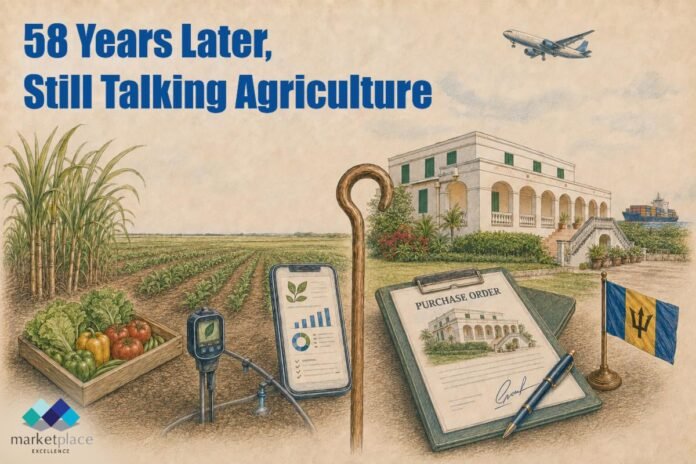
- The economics have shifted. Food insecurity is now a national security issue. CARICOM’s target of reducing food imports by 25 percent by 2030, combined with high freight costs and climate shocks, makes local food production a more profitable option — if it is run as a business.
- The model is market-led. We no longer begin by saying, “Grow more tomatoes.” We start with a proven market — a hotel contract or an export order. That enterprise is the Elephant. Everything else is designed to support it.
- Technology reduces risk. In 1968, biometrics meant using a mainframe computer. Today, a farmer in St. John can access soil sensors, drip irrigation systems and traceability tools through a mobile phone. We can now demonstrate compliance and consistency to buyers.
- Farmers can access affordable financing. Traditional loans have failed them. The Community Equity Trust model offers another way. Under Window A, equity finances the Elephant. Under Window B, 50 small farmers are financed Grameen-style, with inputs provided in kind, repayment made through crops and participants supported by peer guarantees. This is not conventional debt; it is bankable equity. The Financial Services Corporation should find that attractive.
- Shepherding provides the implementation arm we have always lacked. Plans failed because farmers were left to manage alone. Shepherding provides weekly supervision by a Field Officer working with Circles of five farmers and coordinating inputs, extension services and crop collection. In financial terms, this is risk mitigation that reduces the probability of default.
In 1968, I came back to the Caribbean to build a Biometrics Unit. In 2026, I am arguing for a Shepherding Unit to perform the same essential function. Science is still needed, but without the shepherd, it remains on the shelf.
Upwards and Onwards — but this time, let us plan, execute, monitor and control.
Dr. Basil Springer GCM is a corporate governance adviser. His columns may be found at http://www.nothingbeatsbusiness.com.